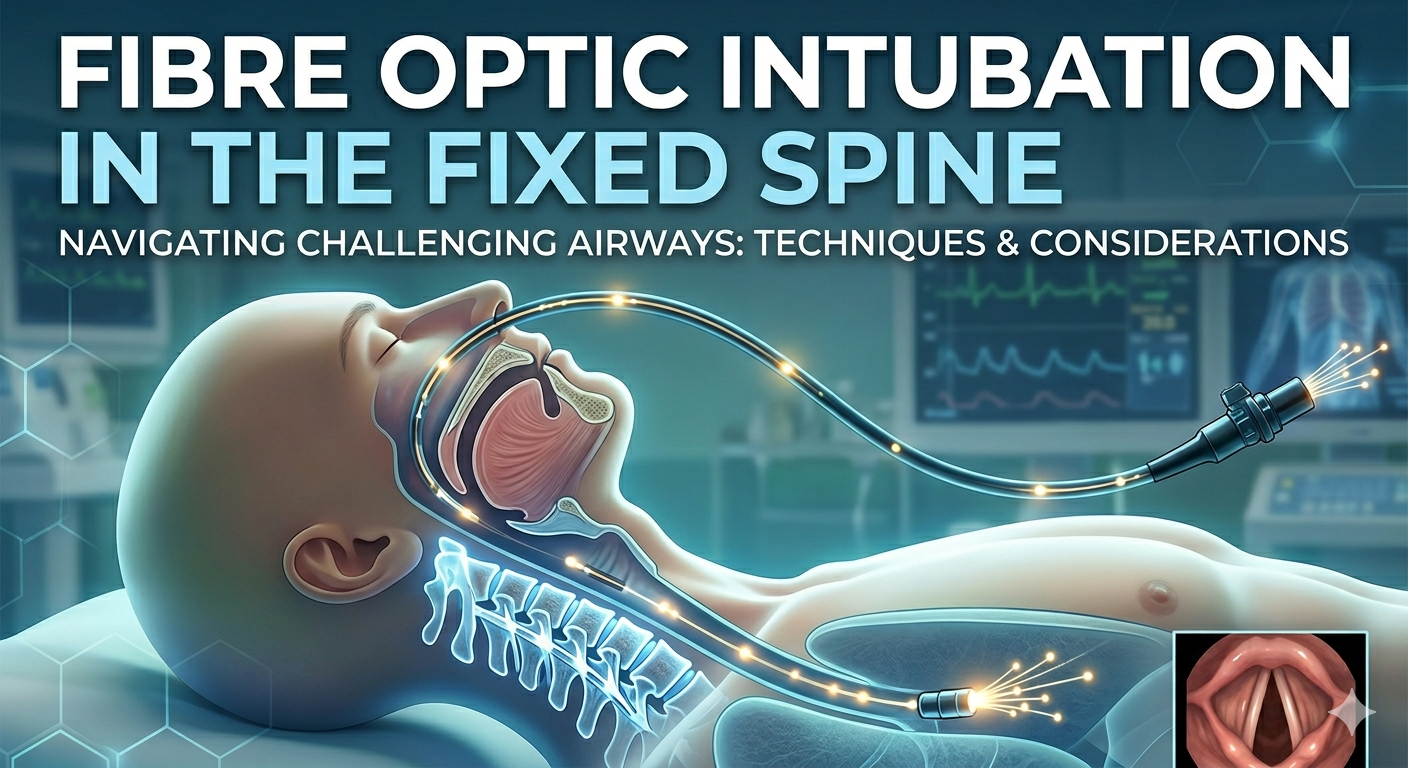
A patient presents for revision spinal surgery. She has a posterior cervical fusion from the occiput to the upper thoracic spine. When the pillow is removed, her head remains fixated mid-air, held rigid by the hardware. The neck does not extend. It does not flex. There is no mouth opening to speak of.
This is not an airway you can manage with a video laryngoscope and a bougie. This is fibre optic intubation territory, and if it is not planned for in advance, the consequences are serious.
When Fibre Optic Intubation Is Indicated
The ANZCA Airway Management Guidelines and the Difficult Airway Society (DAS) guidelines both recommend awake fibre optic intubation as the primary technique when a difficult airway is anticipated and the patient can cooperate [1, 2]. In the context of cervical spine surgery, the indications are relatively clear:
- Cervical fusion involving C1-C2 or occiput to cervical segments. These patients have minimal or no atlanto-axial extension, which is responsible for roughly 25 degrees of the total range of neck extension used during laryngoscopy [3].
- Multi-level cervical instrumentation where the degree of residual movement is uncertain.
- Patients presenting for revision surgery where scarring, hardware prominence, or progressive deformity has further restricted airway access.
- Any patient where conventional laryngoscopy would require cervical movement that risks neurological injury (unstable fractures, incomplete cord lesions, severe stenosis).
The principle is straightforward: if moving the neck is either mechanically impossible or clinically dangerous, the airway must be secured with the neck in a neutral position and the patient breathing spontaneously until the tube is confirmed in the trachea.
The Challenge of the Fully Fused Spine
Multi-level cervical fusion creates a unique set of problems that go beyond simple reduced mouth opening. In a patient fused from the occiput to the mid or lower thoracic spine, the entire upper body becomes a single rigid unit. Head positioning, which anaesthetists rely on instinctively, is not available. The head sits where the fusion dictates.
The practical implications are significant. Standard sniffing position is impossible. Pillow removal does not change the head position at all, because the occiput is fixed relative to the thoracic spine. The patient may have a fixed flexion deformity, meaning the chin is drawn towards the chest, or a fixed extension posture, depending on the surgical construct.
These cases sometimes arrive with prior anaesthetic notes that say "Grade 3 Cormack-Lehane" or "difficult intubation" from a previous encounter. That information is useful but insufficient. What matters is the current state of the fusion, the degree of mouth opening (measured in centimetres, not estimated), and whether the patient can extend the temporomandibular joint independently of the cervical spine.
Pre-Assessment: Where the Work Is Done
The pre-operative assessment is the most important part of managing these airways, and it needs to happen with enough lead time to plan properly.
Assess the fusion extent. Review imaging to understand which levels are instrumented and whether the construct extends to the occiput. A fusion from C3 to C7 with a mobile atlanto-occipital joint is a very different proposition from an occipito-cervical fusion.
Measure mouth opening. Inter-incisor distance below 3 centimetres makes oral fibre optic intubation more difficult and may favour the nasal route [4].
Assess the nasal passage. If nasal intubation is planned, check for septal deviation, previous nasal surgery, or anticoagulation that increases epistaxis risk.
Evaluate the mental state and cooperation. Awake fibre optic intubation requires a patient who can follow instructions, tolerate topicalisation, and maintain their own airway during the procedure. Patients who are anxious, cognitively impaired, or who have had traumatic previous airway experiences need careful preparation and may need additional sedation planning.
Have a plan B. The ANZCA guidelines emphasise that every difficult airway plan must include a fallback strategy [1]. For the fixed cervical spine, this might be a surgical airway performed under local anaesthetic if fibre optic intubation fails. Front-of-neck access should be assessed during the pre-operative visit.
Technique: Practical Considerations
The fundamentals of fibre optic intubation are well covered in training curricula. What follows are the practical elements that matter when the patient in front of you has a rigid cervical spine.
Topicalisation is everything. Inadequate local anaesthesia is the most common reason awake fibre optic intubation fails or becomes distressing. For the nasal route, co-phenylcaine spray and 2% lignocaine gel applied 10 to 15 minutes before the scope is introduced makes a substantial difference. The oropharynx and larynx can be topicalised with 4% lignocaine via nebuliser, spray-as-you-go through the scope, or both. The total lignocaine dose must be tracked. In a 60-kilogram patient, the ceiling is approximately 540 milligrams (9 mg/kg mucosal absorption), but lower doses are preferable [5].
Sedation: less is more. The point of an awake technique is that the patient is breathing and protecting their own airway. Over-sedation in a patient with a fixed cervical spine and limited airway access is a recipe for hypoxia. Low-dose remifentanil by target-controlled infusion (0.5 to 1.5 ng/mL effect site) provides analgesia and mild sedation without suppressing respiratory drive at these concentrations [6]. Midazolam in small increments (0.5 to 1 mg) can be added for anxiolysis, but the temptation to give "just a little more" should be resisted.
Patient positioning. The patient's fixed posture dictates the approach, not the other way around. If the head is in fixed flexion, the oral route may be more accessible because the tongue and epiglottis tend to fall forward. If there is fixed extension with limited mouth opening, the nasal route is usually preferable. The patient should be sitting upright or at 30 to 45 degrees, which helps maintain their airway and gives the operator better ergonomics.
Tube selection. A reinforced (armoured) endotracheal tube is standard for spinal surgery. For nasal fibre optic intubation, a tube one size smaller than usual (typically 6.0 to 6.5 mm for women, 7.0 mm for men) reduces the risk of epistaxis and makes railroading over the scope smoother. Warming the tube in warm saline softens it and improves the curve.
Railroading the tube. The most common point of failure is the tube catching on the arytenoids as it is advanced off the scope into the trachea. A 90-degree counter-clockwise rotation of the tube as it approaches the glottis usually clears this. If it does not pass, withdrawing slightly, rotating further, and re-advancing is preferable to forcing it.
Equipment Realities: Private vs Public
In a tertiary public hospital, the difficult airway trolley is stocked and checked. The fibre optic scope has been serviced. An ODP or anaesthetic technician is present who has set up the equipment before.
In private practice, the landscape can be different. The scope may be a model that is used infrequently. The nursing staff may not have assisted with an awake fibre optic intubation recently, or at all. The topical local anaesthetics may need to be specifically requested from pharmacy.
Dr Hill's approach to these cases involves identifying the equipment requirements at the pre-assessment stage and confirming availability with the facility well before the day of surgery. This includes checking that the fibre optic scope is functional, that an appropriately sized reinforced tube is available, and that the drugs for topicalisation and sedation are drawn up and ready before the patient enters the anaesthetic bay.
The newer single-use disposable video intubation scopes have improved access in private settings significantly. They eliminate the maintenance and sterilisation concerns of reusable fibre optic scopes, and their consistent image quality removes the variable of a scope with a degraded fibre optic bundle. They are not identical to a traditional flexible fibre optic scope in handling characteristics, but for most clinical situations they are more than adequate.
Case-Based Learning: What to Prepare For
Consider a patient presenting for a pedicle subtraction osteotomy revision: a procedure that involves removing a wedge of vertebral body to correct spinal deformity, typically lasting 8 to 12 hours with significant blood loss risk. The patient has a pre-existing fusion from the occiput to the lower thoracic spine and weighs under 60 kilograms.
The airway must be secured before the case begins, obviously, but the anaesthetist must also plan for the possibility that the airway will need to be maintained for the duration of a prolonged and physiologically demanding procedure. Tube security is critical. A reinforced nasal tube, well fixed and positioned above the carina on the initial chest X-ray, is less likely to migrate during prolonged prone positioning than an oral tube.
The pre-operative fibre optic intubation in this context is not just about getting the tube in. It is about getting the right tube, in the right position, secured in a way that will survive 10 or more hours of surgery with the patient prone. It is about confirming bilateral air entry after prone positioning and having a clear plan for what happens if the tube is dislodged mid-case in a patient whose airway cannot be re-secured by conventional means.
These cases are uncommon in private practice and relatively uncommon even in major public centres. They appear in the ANZCA Final Examination because they test the candidate's ability to integrate airway management, physiological resuscitation, and contingency planning into a single coherent anaesthetic plan. They test it because it matters.
Dr Adam Hill is a specialist anaesthetist (FANZCA) practising in Sydney and regional NSW, with particular experience in complex spinal, neurosurgery, and obstetric anaesthesia.
References
- Australian and New Zealand College of Anaesthetists (ANZCA). Guideline on Equipment to Manage a Difficult Airway During Anaesthesia (PS56). Melbourne: ANZCA; 2023.
- Frerk C, Mitchell VS, McNarry AF, et al. Difficult Airway Society 2015 guidelines for management of unanticipated difficult intubation in adults. Br J Anaesth. 2015;115(6):827-848.
- Crosby ET, Lui A. The adult cervical spine: implications for airway management. Can J Anaesth. 1990;37(1):77-93.
- Ahmad I, El-Boghdadly K, Bhagrath R, et al. Difficult Airway Society guidelines for awake tracheal intubation (ATI) in adults. Anaesthesia. 2020;75(4):509-528.
- British National Formulary. Lignocaine (lidocaine) — mucosal and topical dose limits. London: BMJ Group and Pharmaceutical Press; 2024.
- Leslie D, Stacey M. Awake intubation. Contin Educ Anaesth Crit Care Pain. 2015;15(2):64-67.